




The 12th Forum “The Dawn of the Autonomous Driving Era in Japan”EVENTS
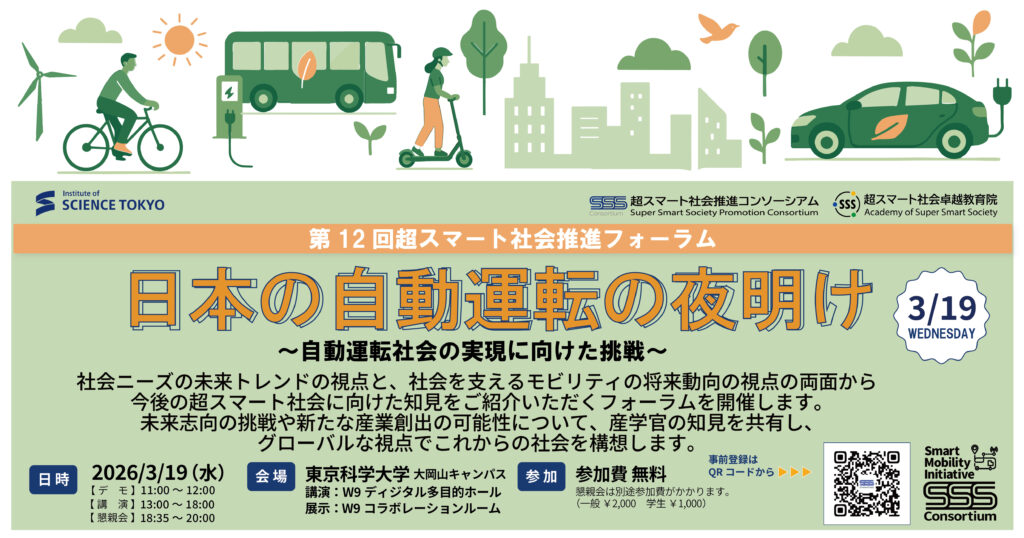
To realize a digital-based Super Smart Society, it is essential to develop social infrastructure that reliably links cutting-edge technologies, including AI, to improving everyday convenience and safety. A central area of this is “Smart Mobility,” which requires the creation of a comprehensive framework that includes AI technology supporting automated driving, infrastructure integration with communications and roads, institutional design and operational environment development to ensure its acceptance as a safe and secure means of transportation, and risk assessment. In Japan, where the population is aging and the birthrate is declining, ensuring sustainable regional transportation and improving productivity across society are urgent issues, and automated driving is a key to resolving these issues. Japan’s integrated policy, technology development, and demonstration efforts could serve as a leading model for contributing to the realization and development of a global super-smart society.
This forum, “The Dawn of Autonomous Driving Era in Japan – Challenges Toward Realizing an Autonomous Driving Society,” will share comprehensive insights into the future Super Smart Society, including national policy trends, various service demonstrations, key technologies such as AI, communication coordination and highway initiatives, and risk assessment. In addition, we will provide an opportunity to experience a concrete vision of an autonomous driving society through dynamic exhibits and video demonstrations.
Event Overview
●Forum :
Date: Thursday, March 19, 2026
Venue: W9 Multi-Purpose Digital Hall, Ookayama Campus, Institute of Science Tokyo
Time: 13:00 – 18:05 Fee: Forum / Free
●Networking (Applicant only, please apply via the on-site application form) :
Time: 18:10 -19:50
Venue: TSUBAME TERRACE, Ookayama Campus, Institute of Science Tokyo
Fee: 2,000yen, *Student 1,000yen
●Organizer, Co-sponsored, Support, Endorsement :
Organized by Super Smart Society Promotion Consortium
Co-sponsored : Science Tokyo, Academy for Super Smart Society, Visionary Initiative : Innovative-Life Society
Support : Japan Electronics and Information Technology Industries Association(JEITA), Intelligent Transport Systems(ITS), Toyota Mobility Foundation, Japan Automobile Manufacturers Association, Inc.(JAMA), Society of Automotive Engineers of Japan, Inc.(JSAE), IEEE Japan Council, Information Processing Society of Japan(IPSJ), The Institute of Electronics, Information and Communication Engineers(IEICE), The Japan Society of Applied Physics(JSAP), The Society of Instrument and Control Engineers(SICE),
Endorsement : Iwata City, Ota City, Meguro City, Tokyo Tech Alumni Association
●Recommended for :
・SSS Consortium partners, University Faculty, Staff, Students, and those interested in our activities
・Those who are interested in Semiconductor technology
Program
Updated as needed
| 時間 Time | 登壇者 Speaker | ||
|---|---|---|---|
| Host:T.B.D | |||
| 13:00~13:05 | Opening Remarks | TBD | |
| 13:05~13:25 | Keynote Speech1 | 「Autonomous Driving from the Perspective of Road Infrastructure 道路分野から見る自動運転について」 Efforts toward the realization of autonomous driving are progressing in many areas across Japan. In the road‑infrastructure sector as well, demonstration projects are underway on road‑vehicle cooperation and the development of driving spaces. This overview outlines the initiatives in the road domain that support the implementation of autonomous driving. |
 |
| 13:25~13:45 | Keynote Speech2 | 「Regional Mobility DX Triggered by Autonomous Driving through Industry–Academia–Government–Community Co‑Creation 産学官”民”共創による自動運転をトリガーとした地域交通DX」 Efforts in Shiojiri City to implement Level‑4 autonomous driving and to promote regional mobility DX triggered by autonomous driving are being supported by local human resources—such as women raising children—through an initiative called KADO, a scheme designed to enable short‑hour employment. This text introduces that case. Mr. Koichi Ota |
-e1770604098933-150x150.jpg) |
| 13:45~14:05 | Lecture1 | 「TIER IV’s Autonomous Bus Technology: Overview and Initiatives」
This presentation outlines autonomous driving technology leveraging the open-source software “Autoware” and introduces our track record in bus operations, including Level 4 certifications and permits. It will explain the journey from nationwide proof of concept tests to deployment aiming to solve regional transportation challenges, along with the latest trends. |
 |
| 14:05~14:25 | Lecture2 | 「Efforts and Challenges Toward the Realization of Autonomous Truck Line‑Haul Transportation Services」
Introduction of a business concept utilizing autonomous trucks and the current status of related activities, along with the challenges that have become apparent in pursuing social implementation. Mr. Shigeto Itaya |
 |
| 14:25~14:45 | Lecture3 | 「Autonomous driving for large vehicles」 We will introduce initiatives aimed at popularizing autonomous driving for large vehicles such as buses and trucks, and will also introduce issues based on the speaker’s experience when deploying autonomous vehicles into real-world traffic environments. Dr. Masaya Segawa |
 |
| 15:00~15:20 | Lecture4 | 「Creating Intelligent Mobility for Safe and Secure Everyday Transportation 安全・安心な生活移動を目指した知能化モビリティの創出」 Prof. Motoki Shino Institute of Science Tokyo Professor, Department of Engineering |
 |
| 15:20~15:40 | Lecture5 | 「Initiatives to Address Communication Challenges for Level‑4 Autonomous Driving Deployment 自動運転レベル4社会実装に向けた通信課題への取り組み」 Regarding the Ministry of Internal Affairs and Communications’ FY2025 Regional Society DX Promotion Package Project (Autonomous Driving Level‑4 Verification Type), this text describes Rakuten Mobile’s initiatives in Saga City to address communication challenges related to autonomous driving. |
 |
| 15:40~16:00 | Lecture6 | 「Automated Driving and V2I Cooperation Enabled by Highly Reliable, Always-Connected Communications」
We believe that highly reliable, mission-critical communications and Vehicle-to-infrastructure (V2I) cooperation are critical technological enablers for achieving SAE Level 4 automated driving. Mr. Shinsuke Funakoshi |
 |
| 16:10~16:30 | Lecture7 | 「Digitalized Infrastructure Maintenance for a Smart Society」
For the social implementation of autonomous driving, the advancement and digitalization of infrastructure maintenance are essential. Mr. Masafumi NAKATA |
 |
| 16:30~16:50 | Lecture8 | 「SOMPO’s Challenge for Next-Generation Mobility」
Japan is currently facing increasingly complex problems, such as transportation gaps and a declining population. Sompo will not only leverage its existing insurance business, but also its accumulated experience to develop unique solutions in the field of next-generation mobility and help resolve social issues. Mr. Tatsuya WATANABE |
 |
| 16:50~17:10 | Lecture9 | 「Development and Field Demonstration and Validation of an Autonomous Driving Road-to-Vehicle Cooperation System」
Road-to-Vehicle Cooperation systems are expected to contribute not only to the expansion of the operational design domain and smoother operation of autonomous vehicles, but also to safety support for manually driven vehicles and traffic analysis. This presentation reports on system development and discusses the field demonstration and validation through proof-of-concept implementation. Mr. Shingo SUMI |
 |
| 17:10~17:30 | Lecture 10 | 「Creating New Value in Mobility through Real-Time Digital Twins リアルタイム・デジタルツインが実現するモビリティの新たな価値創出」 Building on the real-time digital twin technology already demonstrated on the Ookayama Campus, we introduce the new value created by mobility digital twins—enhancing safety and traffic efficiency, enabling advanced learning for autonomous driving AI models, and realizing highly reliable V2X communication. Prof. Kei SAKAGUCHI |
 |

